I’ll admit it: there was a time I thought glowing, perfect skin meant stacking expensive bottles. Those that cost more than a dinner out. However, as I tested more, worked with a wider range of skin types and budgets, I realised that the ingredient matters far more than the price tag. A well-crafted skin routine, built on the right ingredients, can outperform a luxury lineup that’s missing the basics.
In this post, we’ll walk through how to spot affordable skincare ingredients that deliver real results, how to layer them smartly, what to avoid in overpriced fluff, and how you can build a thoughtful routine without breaking the bank. I’ll also share stories from people (including myself) who made big improvements when they swapped out the “expensive bottle” mindset for the “smart ingredient” mindset.
Why affordable doesn’t mean “cheap quality” and why ingredients matter first
Skincare marketing loves luxury. Big names. Glamour shots. But skincare science reminds us: what drives visible change is how an ingredient interacts with the skin, its mechanism, formula, usage frequency, not just the prestige brand. For example, a roundup of dermatologist-backed ingredients identified 23 ingredients that truly deliver results for ageing, acne, pigmentation, and barrier issues.
And when you look at routines in research, it’s often the basic core steps: cleanse, protect, barrier support that make the difference. A major health-system article states, “Simple is best for your anti-ageing skincare routine.” Therefore, you can achieve strong results on a budget if you focus on the right activities.
The “Smart Affordable” Ingredient Checklist
Before we list specific ingredients, let’s set a little framework. When I look for affordable skincare ingredients, I ask:
- Is there clinical evidence/dermatologist support behind it?
- Is it versatile (works for multiple concerns) rather than super specialised?
- Is it safe / well-tolerated for most skin types (especially if budget means limited trial)?
- Is it widely available in drug stores or budget formulas (so you don’t end up paying luxury markup for the same actives)?
- Does it support a foundation step (barrier repair, hydration, protection) rather than “flash” results that fade?
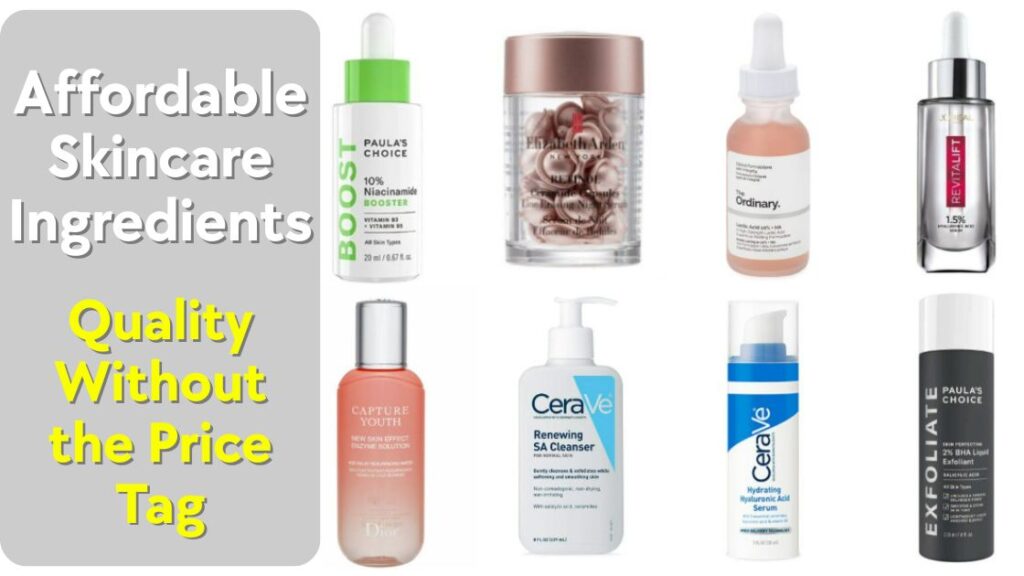
Keeping those questions in mind, here are some of the best affordable skincare ingredients worth your money.
Top Affordable Ingredients You Should Know
1. Niacinamide (Vitamin B3)
Niacinamide is a multitasker. It helps regulate oil production, supports the skin barrier (by boosting ceramide production), reduces redness, and improves uneven tone. Many dermatologists list it as a “must-have” affordable active.
On budget formulas, it’s often found that at 5%–10% that level is enough to deliver visible improvement in texture and tone without premium pricing. Many users report smoother skin, calmer redness, and fewer “reactive” breakout patches. I had a friend whose skin felt tight and blotchy after switching jobs; adding a simple 5% niacinamide serum (and dropping one costly “miracle” night cream) improved tone steadily over 6 weeks.
2. Ceramides
These are lipids that keep your skin barrier intact. When your barrier is weak, you’ll feel tightness, dryness, sensitivity and every “fancy” serum will struggle. According to dermatologist-backed ingredient lists, ceramides rank high for dry skin and barrier repair.
The good news: you’ll find them in many affordable creams, even drug-store barrier formulas. The actives might differ, but the function is nearly identical: replenish your “skin armour.”
My personal note: I swapped a $90 “premium” night cream for a $15 ceramide-rich drugstore jar one winter. Results? My cheeks felt less stinging in cold winds and fewer red patches by morning.
3. Hyaluronic Acid
Hyaluronic acid (HA) draws and retains moisture. While luxury brands may market “molecular weight peptides” or “nano-HA complex,” even standard HA at a good concentration gives real hydration for a reasonable cost. In ingredient lists of “top 8 ingredients” summaries, HA appears as a hydration hero.
Affordable formulas often include HA + glycerin + simple base. The trick: don’t assume “more expensive = bigger effect.” Pair it with a moisturiser and you’re doing well.
4. Salicylic Acid (Low-Cost Exfoliant)
For oily or acne-prone skin, salicylic acid remains one of the most cost-effective actives. According to dermatologist surveys, it ranks high for acne treatment.
You don’t need a luxury brand to use it. A drugstore 2% salicylic gel or leave-on is often enough to reduce clogged pores and texture over time. I once switched a friend from a “luxury exfoliating serum” (very expensive) to a well-formulated 2% salicylic gel, and every 3rd-week texture bump disappeared within 4 weeks.
5. Vitamin C (Affordable Version)
Vitamin C, as an antioxidant and tone-corrector, is a classic. Articles emphasise it for anti-ageing, brightening, and protection.
Budget-friendly versions may use L-ascorbic acid in simple packaging or derivatives like sodium ascorbyl phosphate. If the formula is stable, even the “mid-price” versions deliver. Many luxury brands charge for packaging rather than the exclusivity of the product. I found that a well-priced vitamin C serum changed my complexion’s catchlight in 8 weeks, even though it cost one-third of my previous “luxury” bottle.
6. Squalane (for affordable barrier oil support)
When your skin barrier needs oil support without heaviness, squalane offers lightweight “good oil,” often at modest cost. It doesn’t always headline luxury ad campaigns, but you’ll see it in many affordable “oil-not-grease” formulas. Its usage helps skin feel smoother and retains hydration.
Affordable versions: simple squalane oil + moisturiser with squalane. In my routine, I swapped heavy night oils for a 100ml squalane oil under barrier cream, cost saved, and feel improved.
7. Simple Chemical Sunscreen (Broad-Spectrum)
Okay, yes, sunscreen might trick you into the “expensive product” mindset. But the ingredient priority is critical. Dermatologists emphasise mineral filters like zinc oxide and titanium dioxide. Many affordable sunscreens offer broad-spectrum protection at a decent price. The active priority: choose SPF + filters + texture you’ll actually use every day. The best “affordable ingredient” here is consistency.
How to Build Your Budget-Smart Ingredient Routine
Step 1: Identify your main skin concern
Is it dryness? Oily breakouts? Uneven tone? Barrier sensitivity? Choose 1-2 ingredients from above accordingly. If dry: ceramides + hyaluronic acid. If oily/acne: salicylic acid + niacinamide.
Step 2: Prioritise one “active” at a time
Don’t buy five different “miracle” serums. Choose one active ingredient you introduced (e.g., salicylic acid) and use it consistently for ~8 weeks. Many sources warn that layering too many actives at once leads to irritation.
Step 3: Pair with barrier & protection elements
Even affordable routines need a base: cleanser, moisturiser, sunscreen. Use ceramides, HA, and squalane to support the barrier. Use a budget-friendly broad-spectrum sunscreen.
Step 4: Evaluate results and adjust
After ~8–12 weeks, check if your concern has improved. If yes, great. If plateaued: tweak (change concentration, add second ingredient). But if you add too many products too fast, you may trigger sensitivity and lose results.
Step 5: Look at ingredient labels not price tags
Focus on % of actives (if listed), presence of supporting barrier ingredients, limited irritants (fragrance, unnecessary botanical blends), especially when the budget is tight and trial space is limited.
My Budget Skincare Story (Yes, with a confession)
I used to spend more than what I’d like to admit on “luxury anti-ageing serums.” One day, I counted: I had 10 different bottles on my bathroom shelf, each promising something new. My routine felt overwhelming, and my skin still looked “meh.” Then I pressed reset: I sold/recycled most of the “premium” bottles, kept a basic niacinamide serum (~US $15) + ceramide moisturiser (~US $20) + simple vitamin C (~US $20) + a reliable sunscreen. Within three months, I saw a more consistent tone, fewer red patches, smoother texture, and I spent less monthly. The relief? I felt less “product fatigue.” My partner asked: “Did your skin seriously improve, or did you just stop overwhelming it?” Probably both. The key insight: consistency + good core ingredients > luxury hype.
FAQs (People Also Ask)
1. Can budget skincare ingredients really work as well as expensive ones?
Yes, if the ingredient and concentration are sound. Research shows that effective skincare rests on evidence-based actives more than branding or price.
2. How do I know if a formula is “affordable and effective”?
Look for transparent ingredient lists, well-known actives (e.g., niacinamide, ceramides, salicylic acid), simple formula, and minimal hype ingredients. If the brand focuses more on packaging than ingredient transparency, question the value.
3. Should I buy the cheapest option always?
Not always. Sometimes ultra-cheap means minimal active concentration, poor stability, and higher irritation risks. But you don’t need ultra-premium either. Aim for value-for-ingredients, not just cost.
4. How many ingredients do I need in my routine if I’m on a budget?
Often just 3–5: cleanser, active serum (your concern), moisturiser (with barrier support), sunscreen (day). One additional step (night barrier oil or rest mask) if the budget allows.
5. Can I use multiple affordable activities at once?
You can, but smartly. Introduce one active at a time, monitor the skin, and avoid too many strong actives simultaneously. Over-layering leads to irritation and may negate benefits.
6. How long until I see results with affordable ingredients?
Typically, 4–8 weeks for improvements in barrier and hydration. 8–12 weeks (or more) for texture, tone. Patience matters.
7. Are natural/botanical ingredients always budget-friendly and safe?
No. “Natural” doesn’t always mean effective, and sometimes budget formulas cut active concentration. Focus on the evidence behind an ingredient.
8. Are derm-recommended ingredients always expensive?
Not at all. The dermatologist-endorsed list includes many actives found in affordable formulas (salicylic acid, niacinamide, ceramides).
9. Should I prioritise active ingredient concentration or type?
Both matter. The active type must suit your concern, and the concentration must be sufficient (or used frequently) to drive effect. A low concentration rarely matches a high one, even if same active.
10. Can I layer a high-end luxury product with affordable actives?
Yes, but know what you’re paying for. If your luxury product offers minimal active value beyond the affordable one, you may not receive a proportional benefit. Use the luxury product if it contains unique, high-efficacy actives you need and are not on a budget.
Final Thoughts: Quality Doesn’t Require Pricey Labels
Affordable skincare doesn’t mean “cheap.” It means smart. It means understanding your skin’s needs, choosing ingredients that deliver value, and ditching the pressure to “buy prestige.” The real win is consistency, barrier health, protection and smart actives, not the most expensive dropper in your drawer.
So next time you shop, ask: “What ingredient am I paying for and does my skin need it?” If the answer is yes and you feel confident in usage, you’re already ahead of many. Build your routine around what truly matters and leave the sticker shock behind.
Your skin will thank you. Your wallet will too.
TL;DR Summary Box
- You can get real results with budget-friendly ingredients if they are evidence-based (niacinamide, ceramides, hyaluronic acid, salicylic acid, vitamin C, squalane).
- Focus on ingredient value, not just brand price.
- Build a simple routine: cleanser, one active ingredient, moisturiser, and sunscreen.
- Introduce actives slowly, support your barrier, and monitor your skin.
- Consistency beats luxury stacking every time.