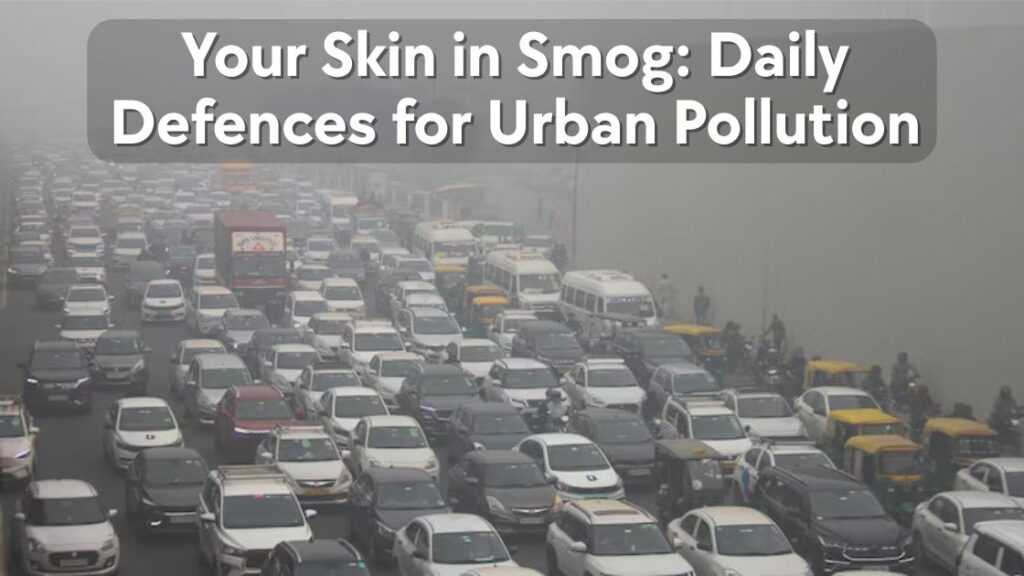
The other evening, I walked home in Delhi and couldn’t help but feel it: that familiar “film” on my skin, the slight sting around my nostrils, and the way my moisturiser seemed to vanish faster. It’s not just seasonal. It’s the air. When pollution rises, your skin isn’t just breathing the same air; it’s reacting.
Living in a city with high pollution (especially with rising smog seasons) changes the game for your skincare routine. We’ll walk through why pollution affects your skin, what actually happens behind the scenes, how your routine needs to adjust, and practical steps you can use now to protect your skin even when the air isn’t cooperating.
What exactly does “pollution” mean for skin?
When we talk about “pollution” in relation to skin, we’re not just talking about visible smog or haze. We mean fine particles like PM2.5 and PM10, nitrogen oxides, ground level ozone, volatile organic compounds, soot, heavy metals, and other airborne stressors. These pollutants settle on, penetrate, or interact with your skin surface and can trigger a variety of damaging processes.
Studies show that skin exposed to high air pollution experiences oxidative stress, barrier breakdown, increased sebum, inflammation and signs of ageing.
In cities like Delhi, where AQI often spikes into the “unhealthy” or “hazardous” range, the skin faces constant assault, which means your skincare must step up too.
Why does your skin feel different on polluted days
Oxidative stress & free-radical damage
Pollution brings in free radicals, unstable molecules that damage skin cells, lipids, proteins, and DNA. A review found that “air pollutants damage the skin by inducing oxidative stress.” PubMed: The result? Dullness, early fine lines, and weaker infrastructure beneath your skin’s surface.
Impaired skin barrier & moisture loss
Airborne particles and chemicals disrupt the skin’s outer layer (the stratum corneum), reducing its ability to hold moisture and protect. One study noted: “Living in a polluted environment may also reduce skin moisture, increase the rate of sebum excretion…” So your skin can feel tighter, drier, or paradoxically oilier where the barrier tries to compensate.
Pigmentation & tone irregularities
Certain pollution components (soot, PAHs, poly-aromatic hydrocarbons) trigger melanogenesis (pigment formation). Research indicates increased pigment spots with soot exposure. That explains why many city-dwellers report stubborn dark spots, uneven tone or “city skin”.
Inflammation, acne & sensitivity
If your pores are clogged with tiny particles and surface stress is high, inflammation rises. Studies link pollution to worsening acne, atopic dermatitis, and psoriasis flare-ups. So if you notice your breakout pattern changing when smog sets in, you’re not imagining it.
Microbiome disruption
Emerging research suggests pollution disrupts the skin’s microbial ecosystem, which can affect everything from barrier health to inflammation.
My own “smog-season” skin story
One winter, I found myself in this loop: waking up, stepping outside into grey-hued air, and my skin by midday looked tired, patchy around cheeks, and my usual moisturiser felt like it was working less. I chalked it up to fatigue. Then I tracked a few days: high AQI mornings correlated with skin feeling more “tight”, more makeup sliding off,and more dryness.
I switched things up: I layered a “pollution-protective” antioxidant serum, used a richer barrier cream at night, rinsed my face immediately after coming in from the street, and used an air-purifying filter indoors. After two weeks, the “film” on my skin reduced, and the tight-feeling dropped. That told me: when the air changes, your skin routine must change too.
Skincare Routine Tweaks for High-Pollution Days
Your daily routine doesn’t have to be a full overhaul, just smarter. Here’s how to adapt.
Morning Routine
- Gentle but effective cleanse: Use a mild cleanser that removes pollutants without stripping your skin’s barrier.
- Antioxidant serum: Choose formulas with vitamin C, niacinamide, green tea, or other antioxidant boosters to counter free-radical damage.
- Barrier moisturiser: Use one rich in ceramides, peptides or lipids, especially if you feel your skin is tighter or drier.
- Sunscreen: Don’t skip. Even on grey days, the UV + pollutant combo still works against you.
- Protective finish (optional): Some people use a light mist or even a powder with protective minerals to reduce particle adhesion.
Evening Routine
- Double cleanse (optional): If you’ve been outdoors, a light oil-based or micellar step can help remove surface particles. Then follow with your regular cleanser.
- Treat serums carefully: If using actives (retinoids, acids), check your barrier strength, as pollution means your skin may tolerate less.
- Rich overnight moisturiser: Focus on barrier repair; choose ingredients like ceramides, panthenol, and squalane.
- Extra step (1-2x/week): Consider a mild clay mask or a soothing sheet mask to detox and calm.
Habit & Environment Adjustments
- Use an indoor air purifier or filter if possible.
- Wash your face and hands as soon as you return from outdoors to reduce pollutant buildup.
- Keep hydrated, both internally and externally. Dry air + pollutants = double-strain.
- Monitor when AQI spikes and consider limiting outdoor exposure, or cover up (scarf, sun-hat) when outside.
- Choose fragrance-free, gentle supporting products if your skin is under extra stress, so it may be less tolerant.
When Pollution Hits Your Skin: Mistakes to Avoid
- Using harsh exfoliants every day: Your skin’s already stressed; over-exfoliation worsens barrier damage.
- Assuming your usual routine works as well: High pollution means more stress,, and your skin’s tolerance shifts.
- Ignoring indoor pollution or ignoring nighttime routines: Outdoor isn’t the only issue; indoor pollutants + poor ventilation matter too.
- Skipping patch-feel changes: If your skin feels different (tight, more reactive, flaky), you may need to scale back actives.
- Relying only on topical skincare without habit changes: Skincare helps, but reducing exposure + improving the environment are equally important.
FAQs (People Also Ask)
1. How does pollution affect skin ageing?
Air pollution accelerates skin ageing by inducing oxidative stress, damaging collagen and elastin, and causing pigment spots and fine lines. Research shows higher pigment spots in polluted areas.
2. Can pollution cause acne or clogged pores?
Yes pollutants (particles, soot) can clog pores, increase sebum, and trigger inflammation. One review found pollution may worsen acne in high-exposure regions.
3. Is my indoor skin safe from pollution?
Not entirely. Indoor air can carry pollutants from outdoors, especially if windows are open, ventilation is poor, or there are indoor sources. Using purifiers and cleaning regularly helps.
4. Do I need a different moisturiser in high-pollution seasons? Often, yes, choosing one richer in barrier lipids, less functional actives, and more protective makes sense when external stress is high.
5. Will pollution reverse my skin improvements?
It can slow progress or cause setbacks if not addressed. That doesn’t mean all progress is lost, just that you’ll need additional protective steps.
6. Are pollution-protective skincare products worth it?
Studies show formulations targeted at pollution-induced damage help reduce the effects of pollutants on skin. So yes, they can help, but they’re a supplement to habits + environment control, not a fix-all.
7. How often should I cleanse when the air quality is bad?
You need to find a balance: cleansing more often can remove pollutants, but over-cleansing can damage your barrier. Twice a day is usually safe for most; once more if you’re outdoors heavily.
8. Does pollution affect people with sensitive skin differently?
Yes, if your barrier is already weak or skin reactive, pollutants can trigger larger reactions (redness, flares). Extra gentleness + protection is needed.
9. Can diet or supplements help mitigate pollution damage to skin?
Yes, to some degree, antioxidants from diet (vitamin C, E, polyphenols) support the skin systemically. But they don’t replace topical protection or reducing exposure.
10. What immediate signs does my skin show that it is reacting to air pollution? Cues like sudden dryness, tightness, redness, more frequent breakouts, makeup sliding off faster, tiny black specks on the surface, or uneven tone.
Wrap-Up: Treat Your Skin Like It’s on the Frontline
When the air around you is heavy with particles, gases, and invisible irritants, your skin acts as the first defender, and it gets tired. If you’re living in a polluted environment, your routine needs awareness, adaptation and extra care.
Start by treating your skin kindly: reinforcing the barrier, using antioxidants, reducing additional stresses, and cleaning gently. Also, consider your habits and surroundings, including air quality, indoor filters, and the time you spend outdoors. Because when you protect your skin against pollution, not just for make-up and glow, you win resilience.
Your skin doesn’t have to surrender to smog season. With thoughtful routines, realistic expectations, and small protective steps, you can keep skin calm, comfortable and less at the mercy of unseen air stress.
TL;DR Summary Box
Pollution (especially in urban environments) damages skin through oxidative stress, barrier breakdown, pigmentation and inflammation. To protect skin: choose barrier-supporting skincare, antioxidants, gentle cleansing, an indoor air strategy, and adapt your routine when air quality drops. Your skin wins when you combine care + context.